BSP Architecture — The Three Layers
Version 0.2 | Ambrósio Institute
Overview
The Biological Sovereignty Protocol is organized into three distinct layers. Each layer has a clearly defined responsibility and is designed to be independent — changes to one layer do not break implementations of another.
┌─────────────────────────────────────────────────────────┐
│                  INTELLIGENCE LAYER                      │
│         AVA · SVA · Third-party algorithms              │
│    (above the protocol — not defined by BSP)            │
└─────────────────────────────────────────────────────────┘
                           │
┌─────────────────────────────────────────────────────────┐
│              LAYER 3 — BSP-Exchange                      │
│           Communication Protocol                        │
│   How systems request and respond with biological data  │
└─────────────────────────────────────────────────────────┘
                           │
┌─────────────────────────────────────────────────────────┐
│              LAYER 2 — BSP-Data                          │
│           Biological Data Schema                        │
│   Structure of all biological measurements (BioRecord)  │
└─────────────────────────────────────────────────────────┘
                           │
┌─────────────────────────────────────────────────────────┐
│              LAYER 1 — BSP-Identity                      │
│           Biological Identity                           │
│   The sovereign identity object — BEO                   │
│   Stored on Arweave — permanent, decentralized          │
└─────────────────────────────────────────────────────────┘
Layer 1 — BSP-Identity
What it defines: Who holds the data.
Every individual and every institution in the BSP ecosystem has a permanent, decentralized identity:
- BEO — Biological Entity Object (individual)
- IEO — Institutional Entity Object (laboratory, hospital, platform, etc.)
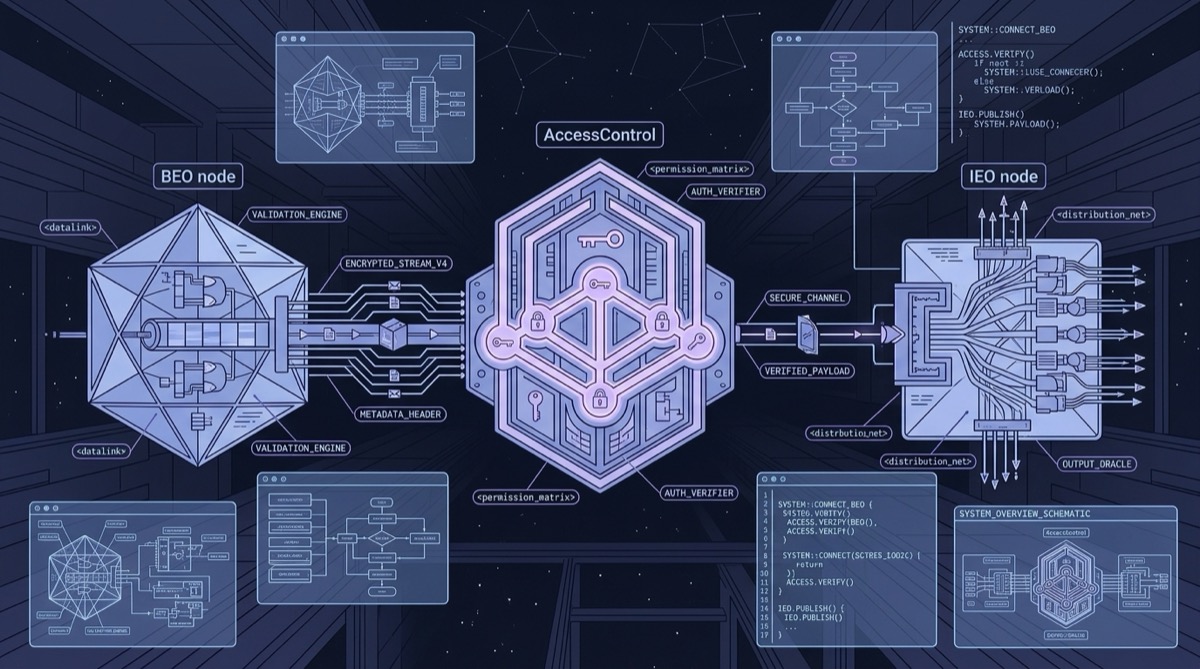
The BEO is the center of gravity of the entire protocol. Every BioRecord, every consent, every interaction is anchored to a BEO.
BEOs and IEOs are stored on the Arweave blockchain — persistent and decentralized. No company, government, or the Ambrósio Institute itself can alter a registered identity. The individual retains the right to render their data permanently inaccessible through cryptographic erasure.
Key identity operations include:
- Lock/Unlock — Temporarily freeze a BEO to prevent any data exchange (useful during key compromise investigations or travel)
- Domain Transfer — Transfer an institutional
.bspdomain to a new owner entity, recorded on-chain with full audit trail
→ See beo.md and ieo.md for complete specifications.
Layer 2 — BSP-Data
What it defines: What the data contains.
Every biological measurement — a blood test result, a genomic marker, a wearable reading, a clinical assessment — is represented as a BioRecord.
BioRecords are the atomic units of biological data in the BSP ecosystem. They are:
- Immutable — once written, they cannot be altered (but can be made permanently inaccessible through cryptographic erasure)
- Anchored — every BioRecord belongs to a specific BEO
- Classified — every BioRecord carries a BSP taxonomy code
- Signed — every BioRecord carries a cryptographic signature from the submitting entity
→ See biorecord.md for the complete BioRecord specification. → See Biomarker Taxonomy for the full biomarker taxonomy.
Layer 3 — BSP-Exchange
What it defines: How data moves.
The BSP Exchange Protocol defines the format of requests and responses between systems:
- How any system submits data to a BEO
- How a platform requests read access
- How an AI engine queries a biological history
- How consent tokens are structured and verified
- How BEO holders manage their intents — adding or removing authorized operation types (
addIntent/removeIntent) on active consent tokens without revoking and re-issuing them
All exchange operations are subject to the AccessControl smart contract — the BEO holder's consent is required for every data transaction.
→ See exchange.md for the complete Exchange Protocol specification.
Decentralized Infrastructure
BSP records are stored on Arweave — a permanent, decentralized storage protocol designed to preserve data for 200+ years.
Aptos smart contracts (Move modules) managing BEO identities, domain registrations, and access permissions provide sub-second finality and resource-oriented safety guarantees. This ensures:
- No single point of failure
- No company (including Ambrósio Institute) can alter the rules unilaterally
- Data written to BSP infrastructure persists with integrity, while the individual retains the right to cryptographic erasure
Sovereign Cryptographic Erasure
BSP implements Sovereign Cryptographic Erasure as a core principle. All BioRecords are encrypted with the holder's Ed25519 public key. Destroying the private key renders the data permanently inaccessible — a stronger guarantee than traditional deletion. This satisfies GDPR Article 17 and LGPD Article 18 requirements for the right to erasure.
The five smart contracts in the BSP infrastructure:
| Contract | Purpose |
|---|---|
| BEORegistry | Creates and manages biological identities — open to anyone |
| IEORegistry | Manages institutional identities and certification status |
| DomainRegistry | Controls the .bsp namespace — guarantees uniqueness |
| AccessControl | Manages consent tokens — the true gatekeeper of the protocol |
| Governance | Multi-signature (2-of-3) authorization for critical protocol changes via proposeAction/approveAction |
→ See bsp-domain.md for the .bsp domain system. → See governance.md for the governance model.
The Intelligence Layer (Above BSP)
The intelligence layer is not part of the BSP specification.
BSP defines how data is structured and transported — not what conclusions to draw from it. Intelligence layers such as:
- Ambrósio Vitality Algorithm (AVA)
- Ambrósio Vitality Score (SVA)
- Any third-party analytics engine
...operate above the protocol, consuming standardized BSP data to produce insights. Any system in the world can implement the BSP. Only Ambrósio holds the AVA.
Ambrósio Institute · ambrosioinstitute.org · biologicalsovereigntyprotocol.com