

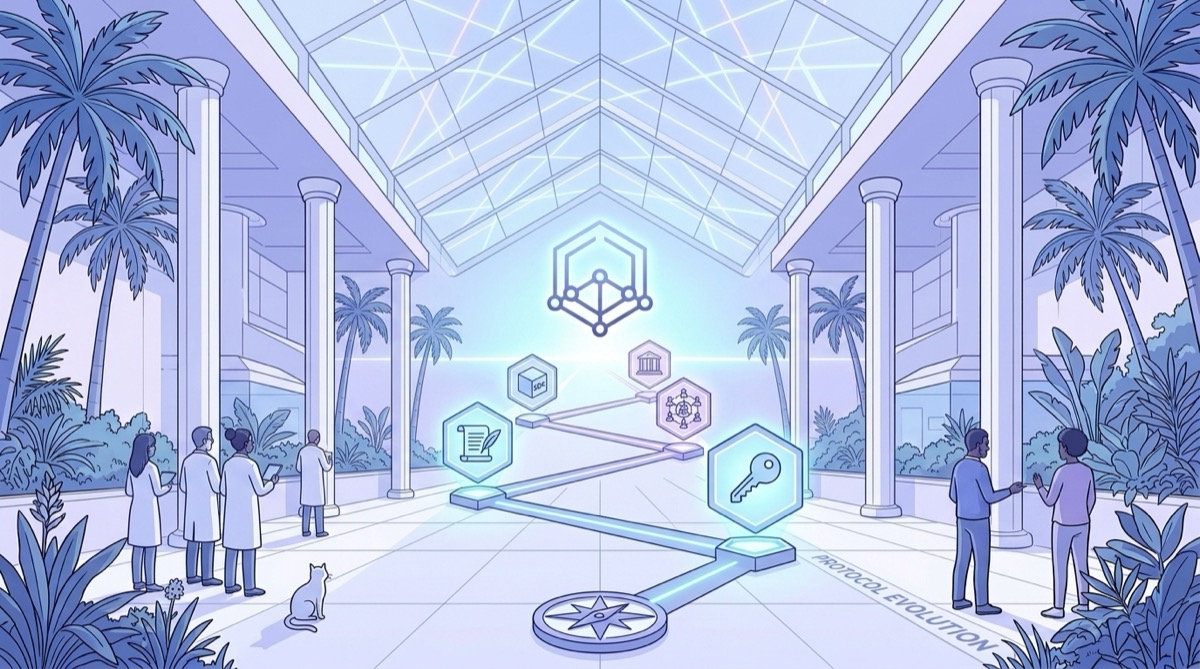
BSP Roadmap
This roadmap is synchronized with Whitepaper v3.0 — Part VI. For full strategic context including adoption strategy and failure modes, see the whitepaper.
Preliminary note — on predicting the future
Roadmaps for decentralized protocols are notorious for aging poorly. The original Filecoin roadmap, written in 2017, promised mainnet for 2018 — it arrived in 2020. Ethereum 2.0, specified in 2018, was still being delivered in fragments in 2024. Every self-respecting whitepaper carries the humility of knowing that time takes its revenge on predictions.
What follows, therefore, is not prediction — it is aspiration anchored in verifiable hypotheses. Every milestone is a bet. Every date is provisional. What matters is not whether we hit the deadlines, but whether the directions remain correct as we learn.
The roadmap below covers 2026–2030. It is organized by technical milestones (verifiable on-chain), adoption milestones (verifiable in public metrics), and institutional milestones (verifiable in publications and partnerships). Each milestone has a binary completion criterion.
Year 1 — 2026 — Operational Foundation
The goal this year is to leave the pre-mainnet state and establish minimum viable infrastructure. We are at ~95% technical readiness in February 2026; the remaining work is multisig, operational security, and the first real users.
| Quarter | Milestone | Completion criterion |
|---|---|---|
| Q1 2026 | Aptos mainnet deployment with active 2-of-3 multisig (BIP-0001) | Contracts published, owner = multisig address, on-chain transaction verifiable |
| Q1 2026 | External audit of the Move contract | Public report published by an independent firm (Trail of Bits, Zellic, or OtterSec) |
| Q2 2026 | bsp-id-web in production | alice.bsp and own-domain functional, first 1,000 BEOs created |
| Q2 2026 | Complete technical documentation | Whitepaper v3 published, Move specification, self-hosted relayer guides |
| Q3 2026 | Stable SDKs (TypeScript v3.0, Python v2.1) | Versions published on npm and PyPI, integration examples documented |
| Q3 2026 | BSP Certified Level 1 program launched | Public criteria specification, first certifications issued |
| Q4 2026 | Pilot partnerships with 3 laboratories | LOIs signed, integrations in staging environment, first real BioRecords |
| Q4 2026 | 10,000 active BEOs | Public on-chain metric, transparency dashboard |
Main risk: delay in audit. Mitigation: audit contracts signed in Q4 2025, with reserved windows.
Year 2 — 2027 — Scientific Validation
In 2027, the focus shifts from infrastructure to scientific legitimacy. Without peer review, BSP is just another promising crypto protocol. With peer review, it becomes a reference.
| Quarter | Milestone | Completion criterion |
|---|---|---|
| Q1 2027 | Peer review submission of AVA methodology | Manuscript submitted to Nature Aging, Aging Cell, or Cell Metabolism |
| Q2 2027 | Validation studies initiated | MOUs with UK Biobank and ELSA-Brasil, IRBs approved |
| Q2 2027 | 25,000 active BEOs | On-chain metric |
| Q3 2027 | 5 IEOs certified Level 2 | Public seals, integration in production |
| Q3 2027 | Native mobile apps beta | iOS and Android with local key management |
| Q4 2027 | Peer-reviewed AVA publication | Paper accepted (not just submitted) |
| Q4 2027 | 50,000 active BEOs | On-chain metric |
Main risk: peer review rejection. Mitigation: parallel submissions to multiple journals; accept that the first round will likely require substantial revisions.
Year 3 — 2028 — Expansion
With scientific validation in hand, 2028 is the year of horizontal scale: more labs, more clinics, more wearables.
| Quarter | Milestone | Completion criterion |
|---|---|---|
| Q1 2028 | 50 certified IEOs | Public directory |
| Q2 2028 | 100,000 active BEOs | On-chain metric |
| Q2 2028 | Client-Side Encryption migration complete | All new BEOs with CSE as default |
| Q3 2028 | Mobile apps in production (App Store, Play Store) | Apple/Google approval |
| Q4 2028 | First community BIP accepted | BIP submitted by an external contributor, approved via public process |
| Q4 2028 | 200,000 active BEOs | On-chain metric |
Main risk: App Store rejection due to regulatory considerations (health apps face a higher bar). Mitigation: engage legal counsel from 2027.
Year 4 — 2029 — Maturity
The fourth year is when the protocol stops being "early stage" and becomes institutional infrastructure.
| Quarter | Milestone | Completion criterion |
|---|---|---|
| Q1 2029 | Independent Audit Council operational | 5+ non-Institute members, charter published |
| Q2 2029 | 500,000 active BEOs | On-chain metric |
| Q2 2029 | Decision on governance token | Public BIP evaluating necessity; decision (yes/no) recorded |
| Q3 2029 | Pilot with public health system | Regional SUS (Brazil) or NHS digital health (UK) — MOU signed |
| Q4 2029 | 1M active BEOs | On-chain metric |
Main risk: institutional bureaucracy stretches deadlines. Mitigation: pilots in jurisdictions where the steward has direct networks (Brazil, Portugal, Estonia).
Year 5 — 2030 — Ecosystem
The fifth year is the real decentralization test: multiple relayers operating independently, multiple client implementations, multiple voices in governance.
| Quarter | Milestone | Completion criterion |
|---|---|---|
| Q1 2030 | 5+ independent relayer operators | Verifiable public list, none controlling >40% of traffic |
| Q2 2030 | AVA validated in 5+ peer-reviewed cohorts | Publications across different cohorts (UK Biobank, ELSA-Brasil, KORA, Rotterdam Study, US NHANES) |
| Q3 2030 | 1.5M active BEOs | On-chain metric |
| Q4 2030 | Public discussion on opening AVA | Public BIP, open RFC, decision recorded |
| Q4 2030 | 2M+ active BEOs globally | On-chain metric |
Symbolic mark: if by 2030 we don't have at least 3 independent client implementations (web, mobile, CLI) and 5 relayer operators, the protocol has failed the real decentralization test and needs to redesign incentives.
Protocol development is community-driven and subject to change through the BIP process. For adoption strategy across the three fronts (individuals, institutions, regulators) and detailed failure modes with mitigations, see Whitepaper v3.0 — Part VI.